


Education Vietnam 2027
May 06 (Thu) ~ 08 (Sat), 2027,
SECC, HCMC, Vietnam
🤖 "Can AI teach you how to manage your allowance?" - A Comprehensive Guide to AI-Applied Financial Education in the 2025 Classroom
17/3/2026
"Teacher, I just asked ChatGPT and it said if I want to save my allowance, I should set aside 30,000 VND every month!"
That was the screen a 7th-grade (middle school) student excitedly showed me in class this past March. The AI had analyzed their 100,000 VND/month allowance, broken down costs for food, transportation, and entertainment, and even suggested a specific plan to save 30%. What was surprising was the student's reaction:
"When I read the textbook, I couldn't relate, but when talking to the AI, I feel like it's talking about my actual money!"
Since that day, a question has always troubled me: Who will be the main guide for financial education in schools? Starting in 2026, the subject "Finance and Economic Life" will be officially included in the general curriculum, and AI-applied learning materials will begin to be selectively used starting in 2025. But are we, the teachers, truly ready? "AI is too hard, and Finance is not my major. How should I teach it?" In this article, we will unravel those anxieties using proven methods from actual classrooms.
Realistic Perspective: Most Teachers Are Interested in AI, But Few Have Started
According to a survey by the Seoul Office of Education of 5,200 teachers, 88.9% expressed interest in ChatGPT. However, there is a large gap between interest and practical application. Many teachers complain: "I don't know where to start."
The same is true for financial education. Regulatory bodies (Financial Services Commission, Ministry of Education) are reviewing the current status and building systematic support measures. Many large financial institutions (Banks, Financial Supervisory Service) are also running financial classes for youth. However, in reality, classes still lack clear direction on "which program to use and how to use it."
Integrating AI technology opens up new possibilities. AI doesn't just impart information; it personalizes interactions with each student, adjusts to their level and interests, provides immediate feedback, and makes repetitive learning less boring. A 2024 study on learning with AI chatbots showed that students' academic confidence increased by 36%, and 80.9% rated AI chatbots as providing reliable answers.
Method 1: "Chatting with an AI Financial Expert" – A Simple 20-Minute Practical Lesson
This is the easiest way for teachers to start. You only need two things: the students' smartphones (or tablets) and a free AI chatbot like ChatGPT.
The class will proceed as follows (45 minutes total):
- Introduction (10 minutes): Begin with the prompt: "Today, you will meet an AI financial advisor." Set a hypothetical scenario: "This month you received 450,000 VND in allowance. You need to buy a 90,000 VND gift for a friend's birthday, and next month you need 300,000 VND for a school picnic. How should you manage your spending?"
- AI Interaction (25 minutes): Students ask the AI questions. The secret here is to teach them how to ask smart questions. The teacher should model this first.
Example Teacher Prompt: "I am a 7th-grade student and received 450,000 VND in allowance this month. I need 300,000 VND for a trip next month, and have to spend 90,000 VND to buy a birthday gift for a friend this week. I usually spend about 120,000 VND on snacks and 60,000 VND on transportation each month. How should I manage my budget? Please arrange it into a table and provide a specific plan." - Intervention & Adjustment: AI usually categorizes income, spending, and calculates the amount to save. This is where the teacher intervenes: "If we follow the AI's suggestion, we won't be able to buy any snacks this month. So what should we do?" Students start proposing alternatives, such as: "How about reducing the snack budget to 60,000 VND and moving the rest to next month?" Then, they ask the AI again.
Through this lesson, students naturally absorb core financial concepts like budgeting, prioritizing spending, compromising, and adjusting.
- Wrap-up (10 minutes): Students take screenshots and submit their conversations with the AI, then each group chooses and presents the "most realistic plan." The teacher concludes with a message: "The AI's advice is not always the absolute right answer. The important thing is to adjust it to fit your own circumstances and values."
Method 2: "Custom AI Financial Quiz Generator" – Personalizing Learning
One of the challenges of financial education is the disparity in students' understanding. Some students are proficient in calculating compound interest, while others do not yet clearly understand the difference between simple and compound interest. AI applications can solve this problem.
When preparing a lecture, the teacher asks ChatGPT to generate a set of questions:
"I want to teach the concept of 'Interest Rates' to 6th-grade students. Please create a quiz consisting of five questions at three difficulty levels (Basic, Intermediate, and Advanced). Each question must include a real-life example and must be multiple-choice. Please provide both the correct answers and explanations."
After reviewing the AI-generated questions (this is a crucial step), they are uploaded to Google Forms or the school's learning platform. Students choose the level that suits their ability and solve the quiz, then self-study by reading the explanations provided by the AI.
To take it a step further, let students directly ask the AI questions: "Give me a math problem about bank deposit interest rates. Make it simple enough for me to understand." Students develop metacognitive skills by explaining to the AI what "they don't know yet."
Important note: Some AI-generated problems might not suit the Vietnamese context or may contain inaccurate financial terminology. Teachers need to verify them against data from the State Bank of Vietnam or official financial supervisory bodies.

Method 3: "AI Financial Scenario Storytelling" – Creativity Alongside Understanding
This method is particularly effective for high school students. Students are given a task: "Use AI to create a story (short webtoon/comic format) giving advice to a young adult (around 20 years old) using a credit card for the first time."
The project class is conducted over several sessions (about 2-3 periods):
- Period 1: Brainstorming and planning AI usage. Each group chooses a topic to explore (credit cards, loans, insurance, or investing), plans questions to ask the AI, and creates a story outline.
- Period 2: Collaborating with AI to create content. Students enter a Prompt into ChatGPT: "Create a 4-panel comic story about a 20-year-old college student making a mistake when applying for a credit card for the first time and how to resolve it. Provide dialogue and specific scene descriptions for each panel." Students edit and supplement the AI-generated story. The key is not to blindly accept the AI's output, but to verify the facts by cross-referencing sources from reputable financial institutions.
- Period 3: Group presentations and feedback. The teacher evaluates the accuracy of the financial concepts, along with peer evaluations via the question: "Which group's story is the most realistic and helpful?"
Through this process, students develop higher-order thinking skills, allowing them to go beyond just memorizing financial knowledge to applying it to real-life situations, explaining it to others, and reframing it creatively.
Method 4: "AI Financial News Curator" – Bridging Current Events and Finance
Every Monday morning, I spend five minutes using AI to summarize the "Financial News of the Week" and share it with the students.
Teachers just need to invest 10 minutes on the weekend:
I ask ChatGPT: "Summarize three major financial news stories from the first week of January 2025 in a way that middle school students can understand. Also, explain how each news story relates to the lives of young people."
Based on the AI's response, I create a short PPT presentation (1-2 slides) and share it with the students. Afterwards, I encourage them to ask questions: "If you have any further questions about this news, feel free to ask the AI."
For example, if the news reports on an "interest rate hike," students will connect the news to their lives by asking the AI questions like: "Why do rising interest rates make borrowing more burdensome?" or "Will my savings interest rate go up too?"
Lessons from Failure: AI is Not a Panacea
A middle school teacher in Hanoi encountered this issue after a financial class using ChatGPT. A student asked the AI: "Can a minor invest in stocks?" The AI replied: "Yes, with the consent of a legal guardian." Although technically correct, the student misunderstood it as: "I can start investing in stocks right now."
There are points that teachers must note and emphasize:
- Ethical Judgment and Suitability: AI can provide legal information, but "what is allowed" and "what is appropriate" are two entirely different matters. Ethical judgment still belongs to humans.
- Currency of Information: AI's information is not always the most up-to-date. Financial systems and laws are constantly changing, so the AI's answers always need to be verified on official websites (State Bank, financial supervisory bodies).
- Limits of Personalization: AI cannot fully understand an individual's specific circumstances. While it can give generic advice like "saving more is a good idea," it is limited in giving personalized advice that takes into account the student's family situation, future goals, and values.
Our classroom also needs rules for using AI:
- Do not blindly trust the AI's answers. Always double-check on official websites (State Bank, financial institutions).
- Do not submit AI-generated results exactly as they are (always add your own thoughts and judgments).
- Do not enter specific personal information (allowance amount, family situation, etc.) during conversations with the AI.
Flexible Application for Each Student Level
- Elementary Students (Grades 4-5): A safer method is for teachers to use AI to pre-generate "money management stories" (e.g., Classing Jello). This helps them naturally get used to saving and spending through engaging stories.
- Middle School Students: Students participate in one-on-one chats with the AI to explore topics like "My own allowance management plan" and "Future careers and necessary financial knowledge."
- High School Students: Preparing for the "Finance and Economic Life" course starting in 2026, students will use AI to compare and analyze complex financial products (funds, ETFs, insurance, etc.). They will prepare for real-life situations by asking specific questions, such as: "Compare the differences between housing savings and regular savings in a table."
A 4-Week Roadmap for Beginner Teachers
- Week 1: Sign up for ChatGPT or a similar AI platform and try it yourself. Ask about 10 finance-related questions.
- Week 2: Download financial education materials for youth from official websites (State Bank, financial institutions). You need a baseline to compare with the AI.
- Week 3: Use AI for just about 5-10 minutes of class time. Don't hesitate to start.
- Week 4: Gradually expand based on student feedback and adjust your methods.

You Are Not Alone – A Community of Teachers Growing Together
Now, our learning is not limited to the classroom. If there is a place where practical ideas converge, where colleagues share failures, successes, and secrets, and where we can receive real-time consulting from EdTech experts, that is the opportunity for the next leap forward. You don't have to struggle alone. Join teachers nationwide, share experiences about AI-applied financial classes, and discover the perfect method for your classroom.
Register now to receive a free visitor ticket: https://educationvietnam.events-regis.com/
Education Vietnam 2026
- Time: 06 - 08.05.2026
- Location: SECC - Saigon Exhibition & Convention Center, HCMC
Bài viết mới nhất
🤖 "Can AI teach you how to manage your allowance?" - A Comprehensive Guide to AI-Applied Financial Education in the 2025 Classroom
17/3/2026
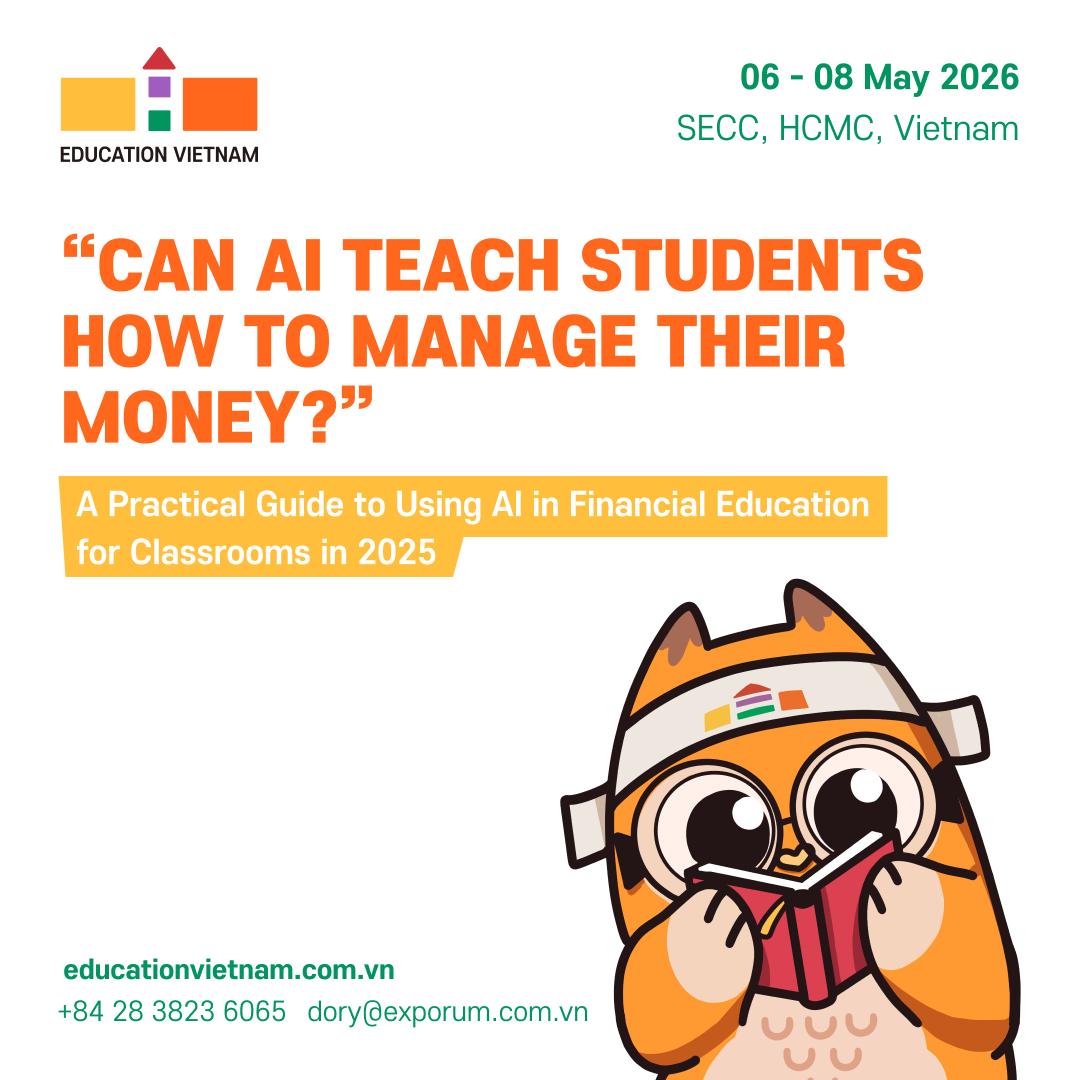
🤖 "AI có thể dạy bạn quản lý tiền tiêu vặt ư?" - Cẩm Nang Toàn Diện về Giáo Dục Tài Chính Ứng Dụng AI Trong Lớp Học 2025
17/3/2026
Visitor Registration is NOW OPEN!
12/3/2026
MỞ CỔNG ĐĂNG KÝ KHÁCH THAM QUAN!
12/3/2026
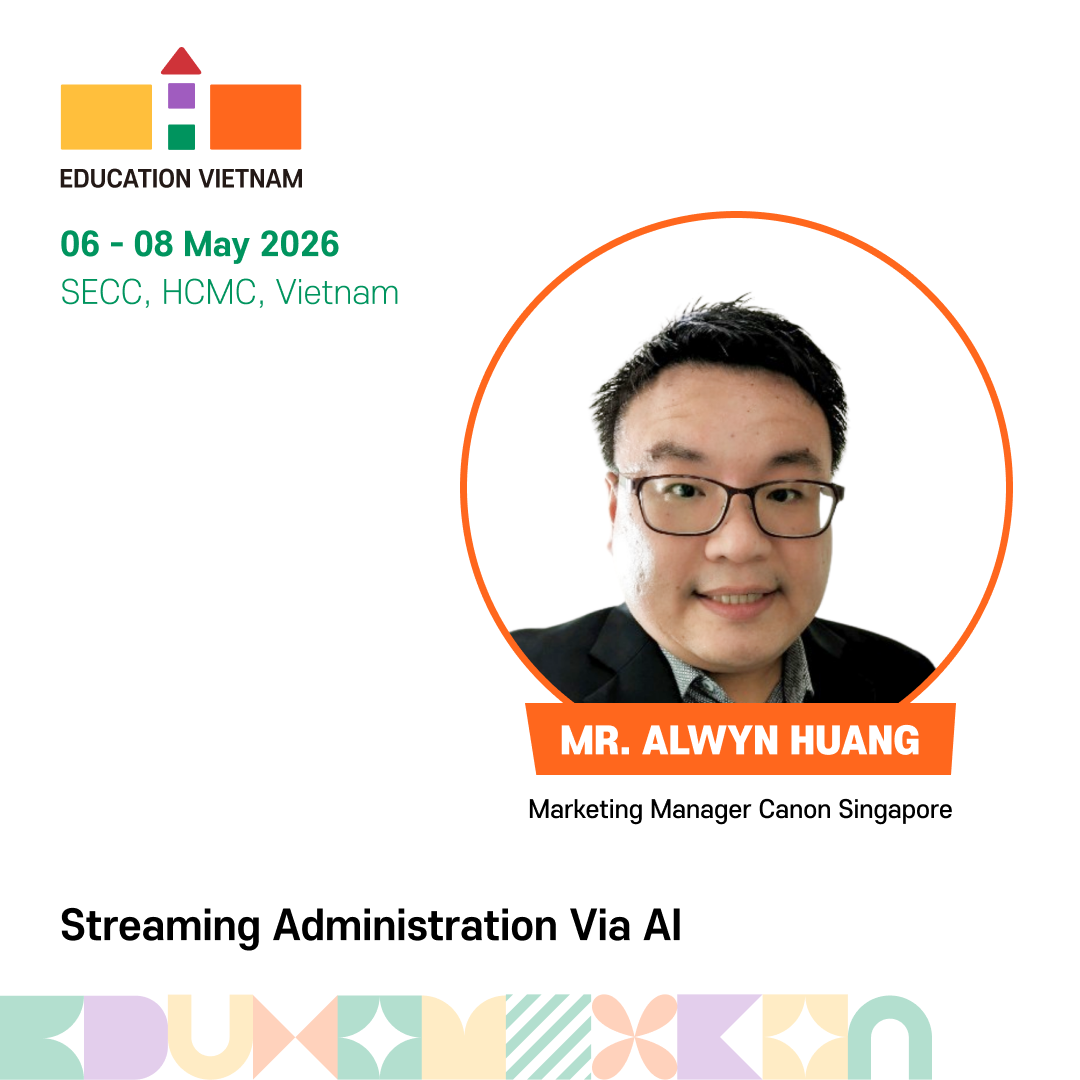
[EDUCON 2025] STREAMLINING EDUCATIONAL ADMINISTRATION WITH AI: RESOURCE OPTIMIZATION SOLUTIONS FROM CANON SINGAPORE
10/3/2026