


Education Vietnam 2027
May 06 (Thu) ~ 08 (Sat), 2027,
SECC, HCMC, Vietnam
Maximizing Personalization in Education: How AI Unlocks Learner Potential at Scale
6/1/2026
.png)
I. Introduction: The Era of Individualization – Why Personalization is Mandatory
In the history of traditional education, the "one-size-fits-all" model was the gold standard. However, as the world enters the digital age, the needs and capabilities of learners have become more diverse than ever. Every student has a unique learning pace, style, and prior knowledge base.
In this context, educational personalization is no longer a luxury or a passing trend; it has become an essential requirement to optimize training effectiveness. At the Education Vietnam 2025 (EDUCON 2025) forum, the session "Maximize Personalization in Teaching and Learning with AI" clarified a vital reality: To achieve personalization at scale, AI (Artificial Intelligence) is currently the only key tool capable of solving this complex equation.
II. Expertise from Ms. Thuy Nguyen and ELSA Corp
The participation of Ms. Thuy Nguyen – Business Development Director for Thailand & Taiwan Markets at ELSA Corp – brought practical and profound insights. ELSA is a household name in the global EdTech industry with its ELSA Speak application. Using AI-driven speech recognition to correct pronunciation for millions of users is the most vivid proof of "personalization at scale."
Drawing from her extensive experience in international markets, Ms. Thuy Nguyen affirmed that AI is not just a hype, but a powerful collaborator that helps bridge the gap between educators and the inherent diversity of students.
III. Why Personalization is Hard to Implement Without Technology
Before the AI boom, personalization relied entirely on the skills and time of the teacher. However, it is nearly impossible for a single teacher to track separate pathways for 30-40 students in a classroom simultaneously.
- Resource Barriers: Tracking progress, grading, and providing individual feedback for every student is administratively overwhelming.
- Data Gaps: It is difficult for humans to accurately remember every micro-learning behavior of each student to adjust lessons in real-time.
- Scalability: While 1-on-1 tutoring is highly effective, it is too expensive to be applied to mass education.
AI has stepped in to fill these gaps.
IV. The Role of AI: Analyzing, Recommending, and Optimizing Pathways
According to the experts at EDUCON 2025, AI acts as a tireless "analytical brain" with three core capabilities:
1. Proficiency and Behavioral Analysis
AI can collect data in real-time. For instance, in language learning, ELSA's AI can pinpoint exactly which syllable a learner mispronounces, where they struggle most, and what time of day they learn most effectively.
2. Tailored Learning Pathways
Based on the collected data, AI automatically adjusts the difficulty of exercises. If a student masters a concept quickly, the AI accelerates the pace. Conversely, if a student struggles, the system immediately suggests remedial exercises. This keeps learners in a state of "Flow"—neither bored by ease nor overwhelmed by difficulty.
3. Instant Feedback
In education, the slower the feedback, the less effective it becomes. AI allows students to know right from wrong instantly, helping them adjust their thinking and learning behavior at the moment of occurrence, rather than waiting for a teacher to grade papers the following week.
V. Technology as Teacher Support: Empowering, Not Replacing
A common fear is that AI will replace teachers. However, the discussion at Education Vietnam 2025 debunked this view. AI functions as an "Intelligent Virtual Assistant":
- Time Optimization: AI handles repetitive tasks such as grading, level placement, and progress reporting.
- Extending Experiences: Teachers can use AI to create interactive lessons and simulations that were previously difficult to implement in traditional classroom settings.
- Enhancing the Human Element: When administrative tasks are handled by AI, teachers have more time to focus on the psychological, emotional, and inspirational aspects of teaching—values that machines cannot replicate.
VI. The Future of Language Training and Digital Education
The future of education, particularly language training, will be a perfect symbiosis between humans and machines. AI will manage skill drills and provide vast resource libraries, while teachers will act as facilitators, mentors, and creators of social practice environments.
Flexibility and effectiveness are significantly enhanced when learners can study anytime, anywhere with an "AI tutor" in their pocket, while still receiving strategic guidance from experienced human educators.
VII. Conclusion: Join Us at Education Vietnam 2026
Ms. Thuy Nguyen's session at EDUCON 2025 profoundly inspired a future where no student is left behind, thanks to the power of AI. Educational innovation is not a destination but a continuous journey.
If you are an educational administrator, a teacher, or an EdTech representative looking for practical solutions to optimize teaching and learning, do not miss the opportunity to connect at the largest educational event of the coming year.
📅 Education Vietnam 2026
- Date: May 06 – 08, 2026
- Venue: SECC – Saigon Exhibition & Convention Center, Ho Chi Minh City
- Website: educationvietnam.com.vn
Are you ready to shape the future of education with AI? Follow our fan page to stay updated on the latest resources and trends!
Bài viết mới nhất
🤖 "Can AI teach you how to manage your allowance?" - A Comprehensive Guide to AI-Applied Financial Education in the 2025 Classroom
17/3/2026
🤖 "AI có thể dạy bạn quản lý tiền tiêu vặt ư?" - Cẩm Nang Toàn Diện về Giáo Dục Tài Chính Ứng Dụng AI Trong Lớp Học 2025
17/3/2026

Visitor Registration is NOW OPEN!
12/3/2026

MỞ CỔNG ĐĂNG KÝ KHÁCH THAM QUAN!
12/3/2026
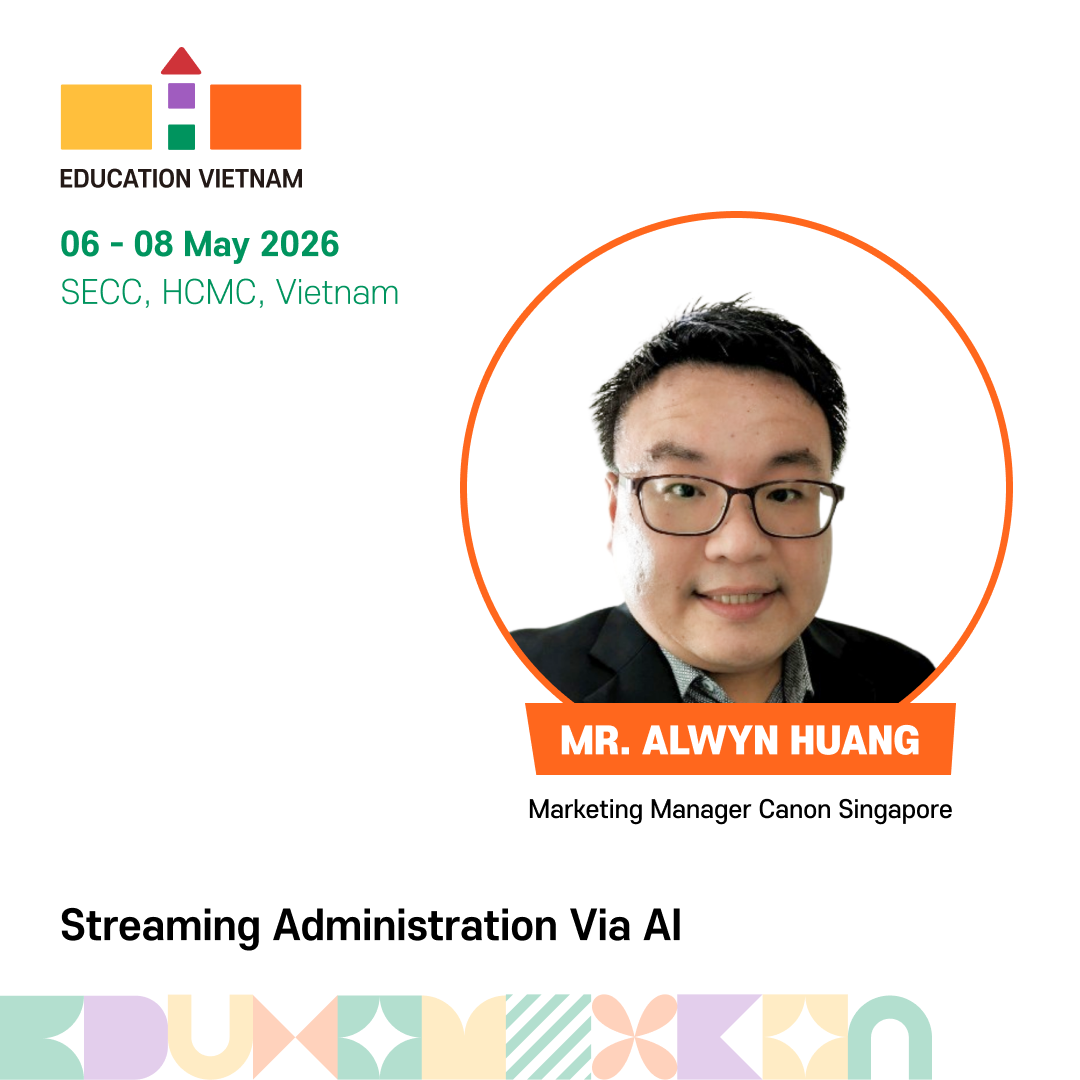
[EDUCON 2025] STREAMLINING EDUCATIONAL ADMINISTRATION WITH AI: RESOURCE OPTIMIZATION SOLUTIONS FROM CANON SINGAPORE
10/3/2026