


Education Vietnam 2027
May 06 (Thu) ~ 08 (Sat), 2027,
SECC, HCMC, Vietnam
Educating for Jobs That "Don't Exist Yet": Challenges and Opportunities at Education Vietnam 2026
20/1/2026
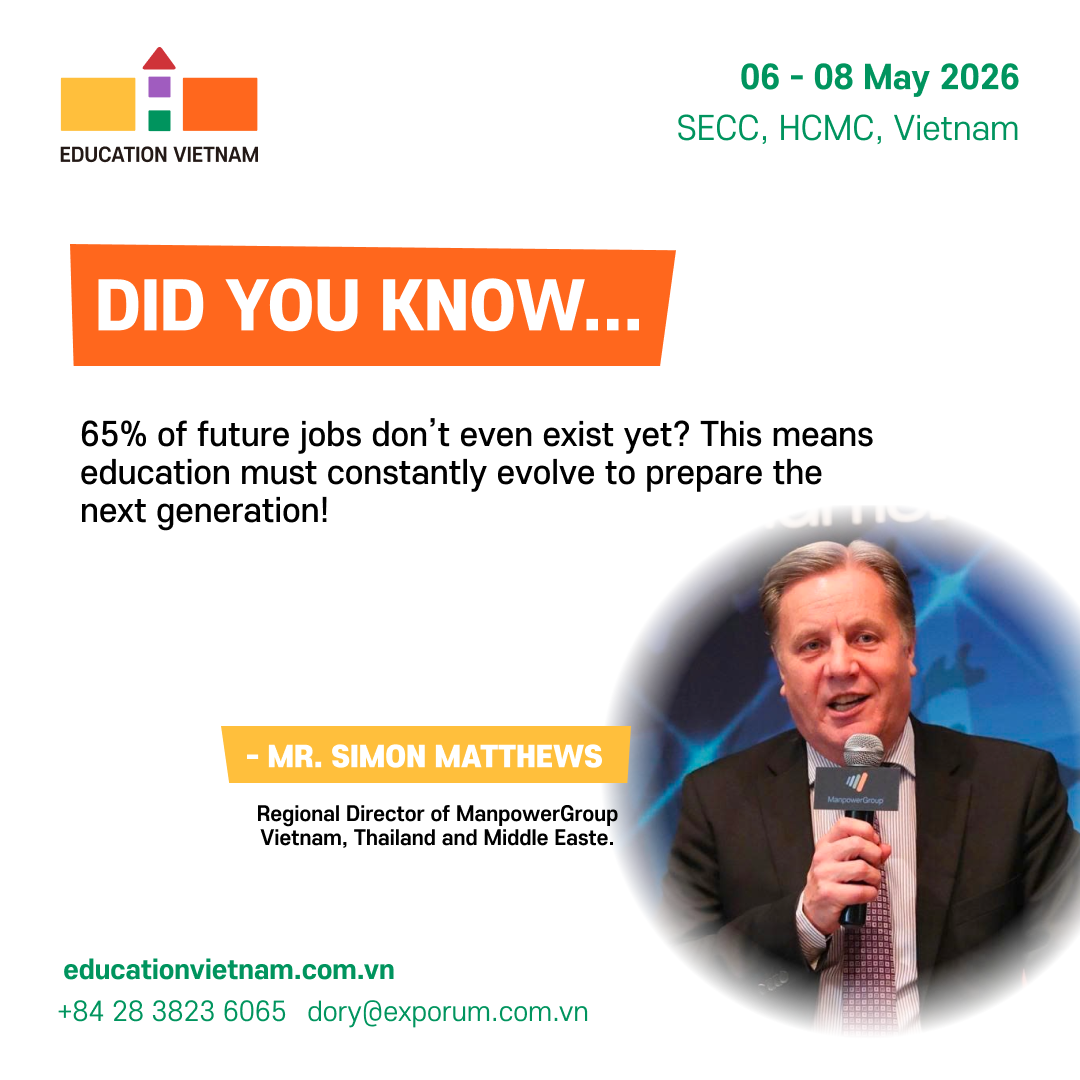
Consider this: A primary school student today will enter the workforce in 10 to 15 years. What will that world look like? Which professions will dominate? The answer is staggering. According to Mr. Simon Matthews, Regional Director of ManpowerGroup (Vietnam, Thailand & the Middle East), 65% of future jobs have yet to be created.
We are training the younger generation for roles that don’t have names yet, using technologies that haven't been invented to solve problems we don't even recognize as problems today. This reality is forcing the entire global education system to redefine its core values.
1. The Paradox of the Future Labor Market
In the past, education focused on the transmission of knowledge (Knowledge-based). Students memorized facts, formulas, and procedures to apply them to stable careers. However, in the era of Artificial Intelligence (AI) and automation, knowledge can become obsolete overnight.
The explosion of the digital economy and new industries—such as renewable energy, biotechnology, and data mining—proves that the most critical skill is not "knowing what" but "knowing how to learn something new." This is why education must shift from delivering data to building mindsets and adaptability.
2. The Three Pillars of Modern Education: Mindset, Skills, and Technology
To prepare for an uncertain future, education must focus on three key elements:
- Growth Mindset: Helping learners embrace change rather than fear it, viewing challenges as opportunities for self-improvement.
- Soft Skills & Emotional Intelligence (EQ): In a world where machines excel at logic, human creativity, collaboration, and empathy become invaluable.
- Digital Literacy: Technology is no longer a standalone subject; it is a mandatory "language" for students to communicate and work within the modern world.
3. EdTech – The Extended Arm of the Educator
To realize personalized learning pathways and equip millions of students with future skills, Educational Technology (EdTech) plays an irreplaceable role. AI helps teachers identify knowledge gaps in individual students; Virtual and Augmented Reality (VR/AR) provide immersive learning experiences; and online platforms blur geographical boundaries.
Technology does not replace teachers; instead, it provides them with more time to fulfill their most vital role: Inspirer and Mentor.
4. Education Vietnam 2026: Shaping the Future of Teaching and Learning
If you are wondering: How can we keep up with these changes? What are the optimal solutions for schools and businesses? The answer lies at Education Vietnam 2026.
This is more than just a trade exhibition; it is a gathering of the most pioneering minds in education. The event serves as a "touchpoint" for:
- Educational Administrators: Seeking strategies and smart school management models.
- EdTech Enterprises: Showcasing breakthrough solutions to the right target audience.
- Teachers and Parents: Updating on trends and tools to support their children's future journeys.
Be part of Vietnam’s premier platform for education innovation and collaboration. Together, we will shape a sustainable future of education where every student is prepared for jobs that "don't even exist yet."
Bài viết mới nhất
🤖 "Can AI teach you how to manage your allowance?" - A Comprehensive Guide to AI-Applied Financial Education in the 2025 Classroom
17/3/2026
🤖 "AI có thể dạy bạn quản lý tiền tiêu vặt ư?" - Cẩm Nang Toàn Diện về Giáo Dục Tài Chính Ứng Dụng AI Trong Lớp Học 2025
17/3/2026

Visitor Registration is NOW OPEN!
12/3/2026

MỞ CỔNG ĐĂNG KÝ KHÁCH THAM QUAN!
12/3/2026

[EDUCON 2025] STREAMLINING EDUCATIONAL ADMINISTRATION WITH AI: RESOURCE OPTIMIZATION SOLUTIONS FROM CANON SINGAPORE
10/3/2026