


Education Vietnam 2027
May 06 (Thu) ~ 08 (Sat), 2027,
SECC, HCMC, Vietnam
Post-Disaster Education in Central Vietnam: Current Situation, Challenges, and Sustainable Recovery Solutions
8/12/2025
1. A Concerning Reality for Education After Floods and Storms
Every year, Central Vietnam endures multiple prolonged storms and floods. From September to November alone, a series of extreme weather events severely damaged the local education system.
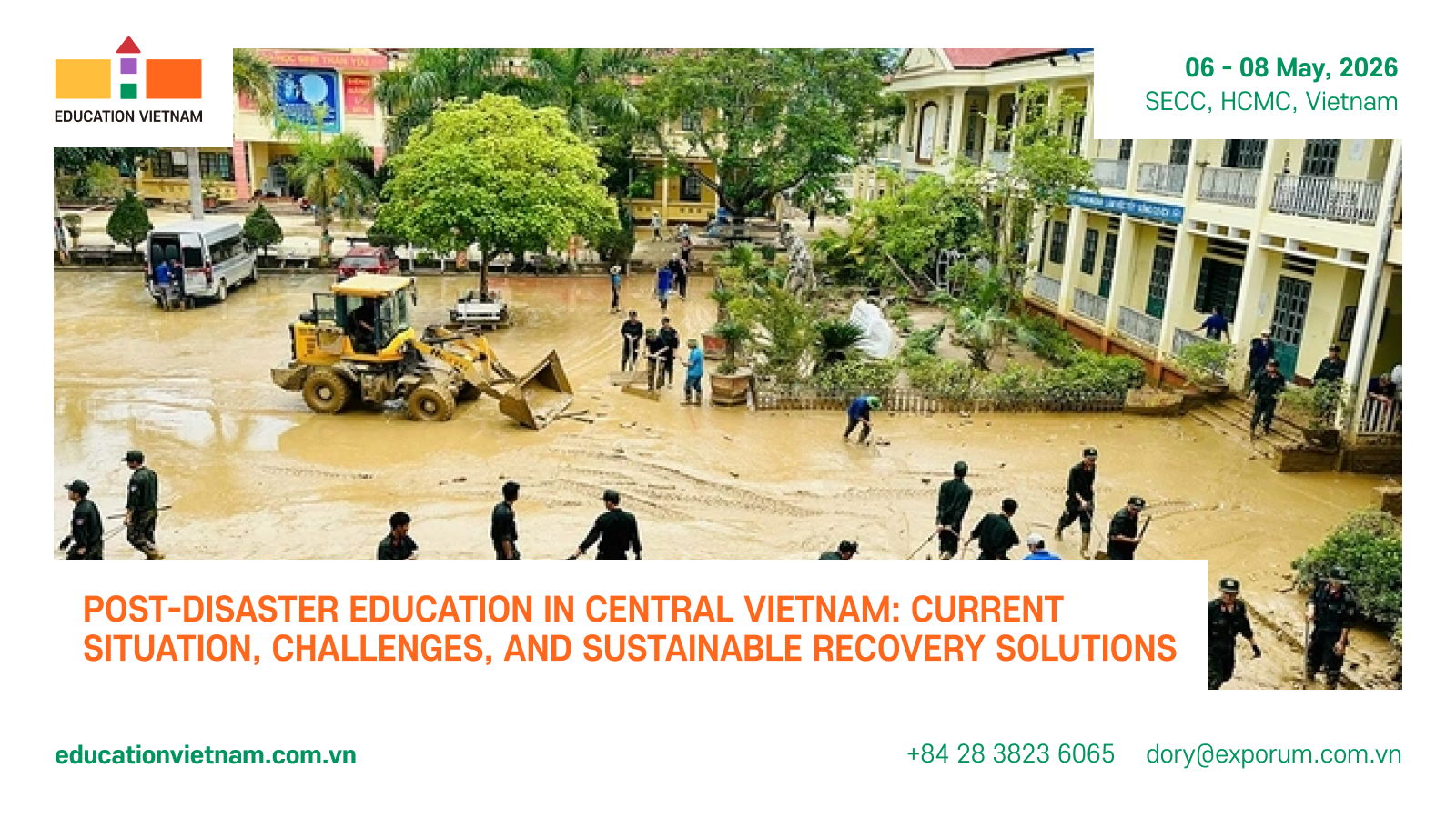
Many schools were destroyed or heavily damaged, teaching equipment was swept away, and students’ books and learning materials were ruined. Hundreds of schools were forced to close for extended periods, causing widespread disruption to learning.
Local teachers face two simultaneous concerns:
— Ensuring the safety of their families and homes
— Maintaining students’ education despite severe shortages
Disadvantaged students and ethnic minority children are the most vulnerable. Many are at risk of dropping out after disasters because they lose books, lack proper clothing to return to school, or their families experience financial hardship.
Beyond physical damage, storms leave psychological impacts on both students and teachers. Fear of rising water, loss of property, and prolonged interruption to learning all affect mental well-being and the ability to return to school.
2. Urgent Needs of Schools and Teachers After Disasters
To restore education after natural disasters, immediate relief is essential. Schools and teachers require support in:
2.1. Repairing and restoring school facilities
- Rebuilding collapsed classrooms and damaged roofs
- Repairing electrical and water systems
- Cleaning and disinfecting school grounds
Some schools in Quảng Bình, Quảng Trị and Thừa Thiên–Huế must remove hundreds of cubic meters of mud after each flood. Without assistance, resuming classes may take months.
2.2. Providing new textbooks and learning supplies
Most affected students cannot afford to replace destroyed school materials. A set of textbooks, backpacks, uniforms or simple stationery can be a financial burden.
Free distribution of textbooks and essential supplies is one of the most practical ways to help students return to school quickly.
2.3. Financial and emotional support for teachers
Many teachers lose their homes yet continue supporting their students. They need:
- Emergency financial assistance
- Teaching devices such as laptops, projectors and digital tools
- Psychological counselling to overcome stress after disasters
Only when teachers regain stability can teaching and learning continue sustainably.
3. Long-Term Solutions for Post-Disaster Education
To prevent future disruption, schools are proposing long-term structural solutions:
3.1. Flexible adjustment of the academic calendar
Because damage levels vary by region, schools suggest:
- Extending the school year
- Reducing testing pressure
- Designing modular catch-up programs
This helps students avoid overload after experiencing trauma.
3.2. Organizing multi-shift or combined classes
Where classrooms are insufficient, schools may temporarily adopt:
- Split-shift teaching (morning–afternoon–evening)
- Combining two classes into one
These approaches help maintain continuity.
3.3. Building a “Disaster-Resilient School Safety Framework”
Teachers hope for a clear set of guidelines including:
- Evacuation procedures
- Methods to protect learning materials and equipment
- Risk assessment protocols
- Contingency plans for remote learning
This framework would help schools act proactively instead of reacting after damage occurs.
3.4. Regular training for teachers
Training programs on:
- Emergency response
- Classroom management during crises
- Psychological support for students
- Flexible teaching methods
will strengthen teachers’ ability to adapt to unpredictable climate patterns.
4. Why Post-Disaster Education Must Be Prioritized
Rebuilding education is not just repairing buildings. It is a long-term recovery process with critical significance:
4.1. Protecting children’s right to education
Without timely support, many children may drop out to support their families or due to lack of resources.
4.2. Restoring mental well-being and community resilience
Schools provide stability and emotional recovery for children after trauma.
4.3. Breaking the cycle of poverty–disaster–dropout
Dropping out increases the risk of long-term poverty. Investing in education helps communities recover sustainably.
Post-disaster education is not only a challenge for Central Vietnam—it is a national priority. When schools and teachers receive timely support, learning can recover more quickly, safely, and sustainably.
Investing in education after natural disasters is investing in the future—ensuring that every child has the opportunity to learn, no matter how difficult their circumstances may be.
Bài viết mới nhất

🤖 "Can AI teach you how to manage your allowance?" - A Comprehensive Guide to AI-Applied Financial Education in the 2025 Classroom
17/3/2026

🤖 "AI có thể dạy bạn quản lý tiền tiêu vặt ư?" - Cẩm Nang Toàn Diện về Giáo Dục Tài Chính Ứng Dụng AI Trong Lớp Học 2025
17/3/2026

Visitor Registration is NOW OPEN!
12/3/2026

MỞ CỔNG ĐĂNG KÝ KHÁCH THAM QUAN!
12/3/2026

[EDUCON 2025] STREAMLINING EDUCATIONAL ADMINISTRATION WITH AI: RESOURCE OPTIMIZATION SOLUTIONS FROM CANON SINGAPORE
10/3/2026